
If you have heard about changes to the NDIS, you may be wondering:
Will my plan change? Could I lose funding? What should I do now?
These are understandable questions. Many people rely on the NDIS for everyday support, independence and connection with their community.
The Australian Government says the changes are needed to reduce fraud, manage rising costs and protect the NDIS for the future. However, participants, families and disability advocates are concerned that some people could lose important support before other services are ready.
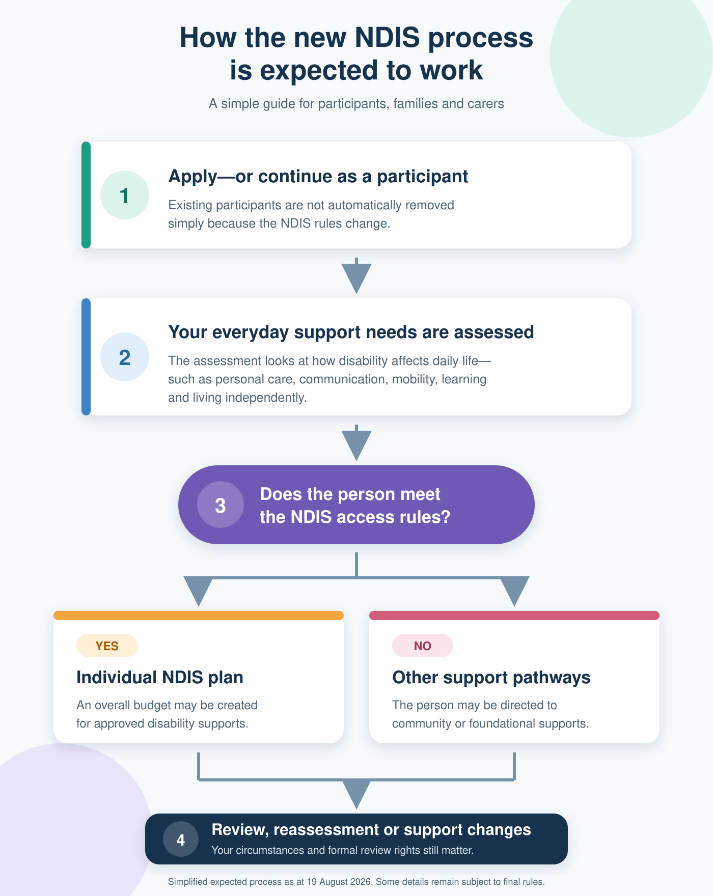
Here is a simple explanation of what is happening.
What is changing?
The government is changing how people qualify for the NDIS, how their support needs are assessed and how their budgets are created.
From 2027, the NDIA is expected to begin introducing a new planning system. Instead of funding each requested support separately, participants may receive an overall budget based on their disability-related needs.
From 2028, eligibility is expected to focus more closely on how a person’s disability affects their everyday life.
For example, an assessment may consider whether someone needs help with:
- Showering, dressing or preparing meals
- Moving around safely
- Communicating with other people
- Learning or making decisions
- Leaving home and using transport
- Working, studying or joining community activities
- Living safely and independently
A diagnosis will still be important, but the effect of the disability on daily life is expected to play a larger role.
How could the new process work?
Under the expected process, a person’s disability and support needs will be assessed.
If the person meets the NDIS eligibility requirements, they may receive an individual plan with an overall support budget.
If they are not eligible, they may be directed to community or mainstream services outside the NDIS. The government calls some of these services foundational supports.
Participants will still be able to have their plans reviewed. If someone experiences a significant and ongoing change in their disability, living arrangements or support needs, they may be able to request a reassessment or plan change.
The reforms will be introduced gradually. Some details may change as the government develops the final rules.
Could my NDIS funding be reduced?
Some types of funding may be affected by the reforms, particularly certain community participation and capacity-building supports.
However, several essential supports are intended to be protected, including:
- Help with personal care
- High-intensity daily support
- Mobility equipment
- Home and vehicle modifications
- Specialist Disability Accommodation
- Some disability-related health supports
- Certain customised and wearable technologies
People who need continuous 24-hour care are also expected to have a special pathway to request additional funding if a broader funding change puts their essential care at risk.
Every participant’s situation is different. The effect of the reforms will depend on the person’s disability, support needs and individual plan.
Will existing participants lose their NDIS plans?
Existing participants will not automatically lose their plans simply because the law changes.
Most reforms will happen gradually. A participant’s funding or eligibility would normally change through a formal NDIA process, such as:
- A plan reassessment
- A plan renewal
- An eligibility review
- A request to change a plan
If the NDIA makes a decision about your plan, ask for the reasons in writing. You may have the right to request a review if you disagree.
Always check the deadline for requesting a review, as time limits can apply.
What are foundational supports?
Foundational supports are services outside the NDIS for people who need disability-related assistance but may not qualify for an individual NDIS plan.
These services could include:
- Early support for children
- Help for families and carers
- Community-based activities
- Information and guidance
- Support for people with psychosocial disability
- Help to access mainstream services
A stronger support system outside the NDIS could benefit many people. However, families and disability advocates are worried that these services may not be ready when people need them.
Before someone is moved away from the NDIS, suitable and properly funded support should be available in their community.
What is being done about fraud?
The reforms are not only about participant funding. They also introduce stronger rules for providers and others who misuse the NDIS.
The changes include tougher penalties for:
- Making false or fraudulent claims
- Providing misleading information
- Destroying important records
- Misusing a participant nominee position
- Offering kickbacks or inappropriate rewards
- Obtaining NDIS money through deception
Participants and plan managers will generally need to keep payment and service records for three years. Providers will need to keep relevant records for seven years.
These measures are intended to protect participants and make sure NDIS funding reaches the people who need it.
Why are people concerned?
For participants and families, the NDIS is more than a government program.
It can provide the support that helps someone get out of bed, communicate, work, study, leave home or live safely and independently.
That is why conversations about reducing costs can feel frightening and personal.
Most people agree that fraud should be stopped and that the NDIS should work more fairly. The concern is about how the changes will be introduced and whether saving money could be placed ahead of people’s safety, dignity and quality of life.
For these reforms to work, participants must be listened to, assessments must be fair and essential supports must remain available.
What should I do now?
There is no need to panic, but it is a good idea to stay informed and prepared.
You can:
- Keep your medical reports and assessments up to date
- Keep copies of invoices and service agreements
- Save emails and letters from the NDIA
- Ask for important decisions in writing
- Read NDIA letters carefully
- Check any review deadlines
- Speak with a disability advocate if you disagree with a decision
- Ask for help if you do not understand information about your plan
A change to the overall NDIS does not mean your individual plan will disappear overnight. Your personal circumstances and support needs still matter.
Merciful Care is here to help
You do not have to navigate the NDIS alone.
If you are worried about the changes or unsure about your next steps, Merciful Care is here to support you.
Our caring team can help you understand your options, connect with suitable supports and feel more confident about moving forward.
Contact Merciful Care today to learn how we can support you or someone you care for.
The NDIS was created to give people with disability more choice, control and independence. As the scheme changes, people with disability must remain at the centre of every decision.
This article reflects information available as of 19 August 2026. It provides general information and is not legal advice. For advice about an individual plan or decision, contact the NDIA, a disability advocate or an appropriately qualified adviser.
Further information
About the Author